

Reviving Georgian Tea in Guria
Once among the world’s leading tea producers, Georgia is now witnessing a quiet revival of this tradition. At the heart of this movement is a new generation of entrepreneurs determined to bring Georgian tea back to life.
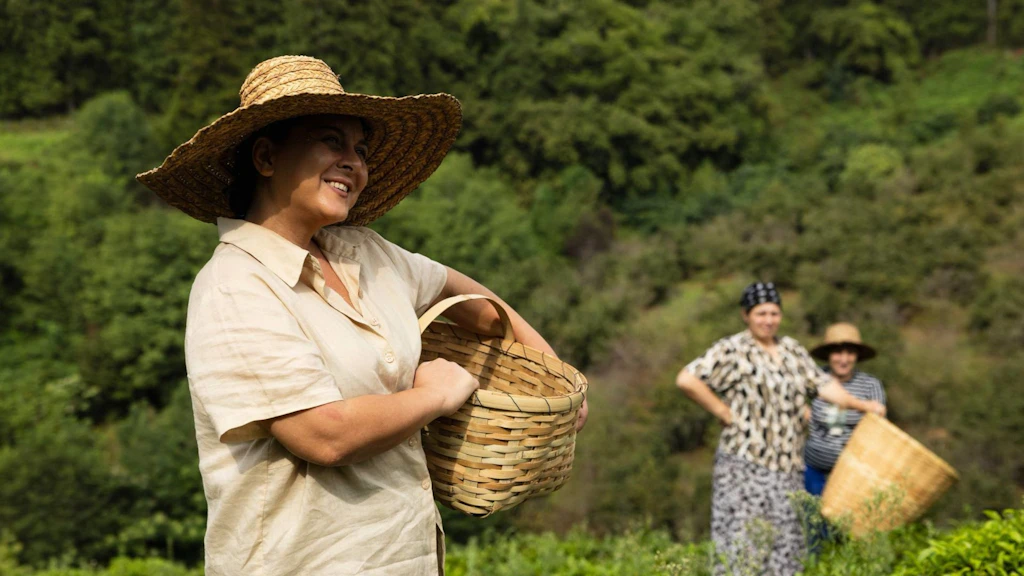
Georgian tea production might not be as old as that of the Georgian wine, but almost equally cherished. While there are several accounts of how tea first arrived in Georgia, its modern history dates back to the 19th century, when Prince Mamia V Gurieli of Guria introduced the first tea bushes. Over time, tea production grew so significantly that Georgia became the world’s fourth-largest tea producer for decades.
Today, this legacy is being revived by a new wave of entrepreneurs. Among them is Lana Zhghenti, a determined young woman from Guria who is working tirelessly to restore the region’s fading tea culture.
Tea production and beyond
Lana is a young female entrepreneur from Guria. Her whole family - parents and siblings - emigrated to Europe many years ago. She herself also left but as she felt homesick, she soon returned to Georgia. Back home, she decided to revive her family’s abandoned tea plantations.
Starting with outdated equipment and limited resources, Lana relied heavily on her family’s support, especially that of her sister. Gradually, she invested in new machinery and expanded her plantations.
“We had a tea plantation that my parents had cultivated for years,” Lana recalls. “I knew how challenging tea production was, but I was determined to revive what my family had built. I could have grown nuts, but there was already a tradition of tea cultivation. It was difficult, but not impossible.”
Determined to grow her business, Lana applied for the “Produce in Georgia” program and received a grant of GEL 15,000, which she used to purchase essential equipment, including a tea roller and leaf dryer.
“We faced many challenges - from lack of funding to lack of knowledge,” she says. “It took me nine years of hard work, failures, and successes to reach where I am today.”
Today, Lana produces four types of tea: traditional black, green, wild blackberry, and wild blueberry. But she did not stop there. Recognizing the potential of tourism, she transformed her plantation into a destination where visitors can pick tea leaves, attend tastings, and participate in tea-making masterclasses.
In 2024, she built a fully equipped enterprise, and a year later, she launched a new initiative—an Oda House, a traditional wooden house typical of western Georgia. It is designed as a small guesthouse for up to four people, but if interest continues to rise, Lana plans to expand the facility.
A Continuous Learning Process
For Lana, growth goes hand in hand with learning. She fully understands that modern challenges require new knowledge.
“I grew up watching my parents work hard, but times have changed,” she explains. “I still consult them often, but I also need to seek information elsewhere.”
She regularly exchanges knowledge with fellow farmers, collaborates with a laboratory in Zugdidi, and has learned modern cultivation techniques from the Anaseuli Research Center. She has also completed courses at the Ozurgeti vocational education college.
Tea Association
The project “Local Economic Development in Georgia,” mandated by the Swiss Agency for Development and Cooperation and implemented by HELVETAS Swiss Intercooperation, facilitated the creation of the Tea Association. The association aims to help local producers improve quality, branding, and market access.
“What we produce is pure, organic tea,” Lana says. “It is hand-picked, carefully processed, and completely natural. But high-quality tea is expensive, and small producers like me struggle to compete with low-priced imports, such as Iranian tea.”
She believes collaboration is key: “Through the Association, we can improve marketing, packaging, and address common challenges together.”
According to Lana, the future of Georgian tea lies in positioning it as a premium organic product. Demand for such products is gradually increasing, both locally and internationally. With stronger branding and marketing, she hopes to expand into retail chains, the HoReCa sector, and eventually export markets.